
Mauritius Is Racing to 60% Renewable Energy by 2030 — Here's Why Solar Leads the Charge
The island is racing to 60% clean power by 2030. Solar is how it gets there.
Mauritius has pledged to draw 60% of its electricity from renewables and phase coal out of its grid this decade. For the island's factories, resorts and utilities, rooftops and open land have quietly become some of the best-performing assets they own. Here's what the shift means — and how to move first.
Mauritius sits in one of the sunniest neighbourhoods on Earth — and for decades it has run its lights on imported coal and oil. That contradiction is now the country's biggest energy opportunity.
The Republic of Mauritius has set a firm course: lift renewables to 60% of the electricity mix by 2030, up from an earlier 40% goal, and retire coal from power generation over the same horizon. Today the grid still leans heavily on imported fossil fuels — close to four-fifths of electricity — which leaves the island exposed to price shocks it does not control. Solar is the fastest, most bankable way to close that gap.
For a small island developing state, this is not only an environmental promise. It is an energy-security strategy, a hedge against volatile fuel imports, and — increasingly — a straightforward business decision. The national Renewable Energy Roadmap 2030 maps roughly USD 1.35 billion of investment into solar, floating solar, wind, biomass and storage. A pipeline of solar and battery-supported projects totalling about 376.8 MW is already in motion.
THE SETUP
Abundant sun, expensive habits
Mauritius enjoys strong, consistent solar irradiation the whole year round — the same climate that fills its beaches also makes its rooftops productive. Yet the island generates most of its power from fuel that arrives by ship. Every barrel and every tonne of coal is a cost set in a foreign market, paid in foreign currency.
Solar flips that equation. Once a system is built, its “fuel” is free and local. That structural advantage is why the government, the Central Electricity Board (CEB) and international partners such as the Green Climate Fund have moved in the same direction — funding grid-scale battery storage, a floating solar farm at the Tamarind Falls reservoir, and thousands of rooftop installations across the island.

“Sun is the one fuel Mauritius already has in abundance. The task is engineering — turning that resource into reliable, dispatchable power.”
THE BUSINESS CASE
Why solar now pays for itself
For commercial and industrial operators, the maths has shifted decisively. Solar projects in the C&I segment have secured connection agreements with the CEB at around 9 US cents per kWh — a rate that compares favourably with grid tariffs and, crucially, stays flat for decades while fuel-linked costs drift upward.
The permitting and build timelines are predictable, too: approvals typically run six to nine months, with construction of a commercial-scale plant taking a further six to twelve months. For a factory, logistics hub, data centre or resort, that means a clear line of sight from decision to generation — and to a lower, more stable cost of energy on the other side.
WHO BENEFITS MOST
Resorts, factories and data centres are the natural early movers. High daytime demand, large uninterrupted roof or land area, and a strong sustainability mandate make hospitality, manufacturing and digital infrastructure the sweet spot for solar in Mauritius. A resort that runs air-conditioning and pools through the sunlit hours is, in effect, matching its biggest load to its cheapest supply.
There is a reputational dividend as well. International guests, brands and investors increasingly scrutinise carbon footprints. A resort or exporter that can point to on-site clean generation is protecting its market position, not just its margin — and doing so in step with the island's national commitment to cut greenhouse-gas emissions by 40% by 2030.
THE SHIFT TO STORAGE
Mauritius is going battery-first
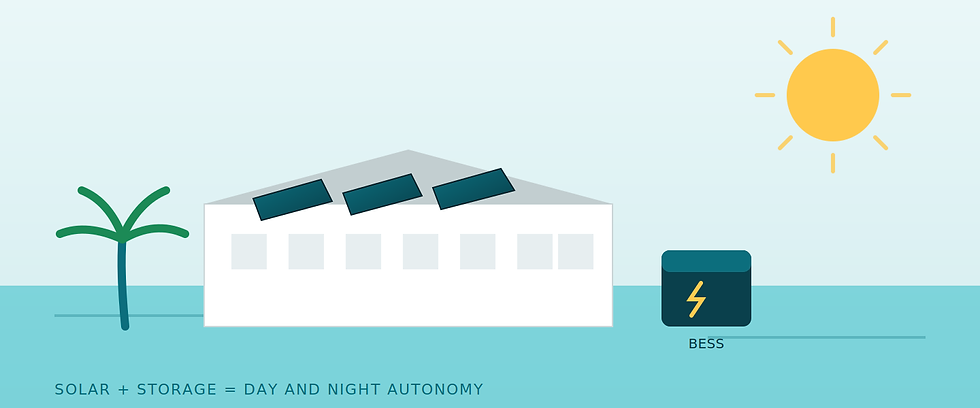
The clearest signal of where the market is heading came with the island's move toward hybrid systems. Under the revamped 2026 rooftop scheme, new installations are expected to pair solar with battery storage rather than panels alone — a policy designed to give homes and businesses genuine evening autonomy and to keep the grid stable as more variable solar comes online.
For businesses, storage changes what solar can do. A battery lets you run on your own power after sunset, ride through outages, shave expensive demand peaks, and get more value from every kilowatt-hour you generate. It is the difference between a system that trims your bill and one that reshapes how your site consumes energy altogether.
HOW PHAENORAN DELIVERS
From feasibility to first watt — engineered end to end
Getting solar right on an island is an engineering problem before it is a procurement one. Salt air, cyclonic wind loads, grid-code compliance and long equipment lifecycles all raise the bar. Phaenoran delivers complete Solar EPC (Engineering, Procurement & Construction) projects designed for exactly these conditions — drawing on 30+ years of experience, more than 500 MW delivered, and execution across 14+ countries.
01 Feasibility & assessment
Site evaluation, energy-consumption analysis, financial feasibility and ROI projections before a panel is ordered.
02 Engineering & design
Rooftop, ground-mounted and hybrid system design with battery integration and full electrical and civil engineering.
03 Procurement
Tier-1 module and inverter sourcing, vendor evaluation, logistics and rigorous quality assurance.
04 Construction
EPC execution for rooftop and utility-scale plants, electrical integration, and full safety and compliance management.
05 Monitoring & automation
SCADA integration, remote monitoring, real-time analytics and predictive maintenance built in from day one.
06 Operations & maintenance
Preventive maintenance and asset-lifecycle optimisation that protect performance across the plant's full lifetime.
Because Phaenoran combines global expertise with regional execution, an island client gets both: the engineering discipline of a team that has built utility-scale plants worldwide, and delivery tuned to local grid rules, timelines and conditions. That is what turns a 2030 target into a working asset on your roof.
THE TOOLKIT
One partner, every solar configuration
No two sites in Mauritius are alike — a beachfront resort, an inland factory, a data centre and a utility parcel each call for a different approach. Phaenoran designs and builds across the full range:
Grid-tied systems
Offset daytime load and export surplus to the CEB grid — the fastest route to lower bills.
Hybrid solar
Solar by day, battery by night, resilience through outages — the island's emerging default.
Off-grid solutions
Standalone generation for remote sites and infrastructure beyond the reach of the grid.
Ground-mounted plants
Utility-scale arrays on open land, engineered for island wind loads and long-term yield.
Battery energy storage
BESS that shaves peak demand, stabilises supply and unlocks true evening autonomy.
EV charging infrastructure
Solar-powered charging that turns clean generation into clean mobility for fleets and guests.
“The 2030 target is a national commitment. On the ground, it becomes thousands of individual decisions — one roof, one factory, one resort at a time.”
The window is open now
Schemes, tariffs and connection agreements are live today, and the project pipeline is filling fast. Every month a site keeps buying fossil-linked grid power is a month of savings and resilience left on the table. The organisations that move early will lock in the best rates, the clearest grid slots, and a genuine head start on the island's clean-energy decade.
Mauritius has the sun, the policy and the momentum. What turns that into power flowing through your meter is disciplined engineering — and a partner who has done it before.
Comments